When reading all the stories about the old masters of karate fighting in real situations, you notice one thing: the fights didn't last more than a few seconds. Yet if you notice the way most people train, whether it is karate, mixed martial arts, boxing, or whatever, they train specifically to exchange blows and use all sorts of tricks. Certainly, they don't preach that one should take a long time to win, but looking at their approach, multiple techniques and combos are viewed as necessary. This exemplifies the notion of having a "boxer mentality" versus Chibana Sensei's concept of "ippon kowashi" or "one technique, total destruction."
The boxer mentality stems from simply tradition, a more sport oriented focus, the belief that it is better to be safe than sorry, or the outright refusal to believe a fight can be ended with a single technique outside of good luck and proper circumstances. In most cases, it is a combination of this last reason with one or more of the others. For these people, combos or advanced techniques are a must because the basic techniques simply aren't strong enough or effective enough to win a fight by themselves.
In traditional martial arts circles, there is disillusionment with the idea of ippon kowashi. Sadly, many of the schools that do believe in it grossly overestimate their skills, which only contributes to that disillusionment amongst the greater martial arts community. Many rational martial artists notice their techniques lack the power needed for ippon kowashi. In brutal honesty, this lack of power comes from having an instructor who couldn't or wouldn't teach them how to generate it properly or simply the student not being good enough to learn it (but usually the instructor is to blame). As a result, these rational martial artists begin to believe martial arts techniques must rely on speed and involve a heavy emphasis on esoteric pressure points, complex grappling, or whatever the flavor of the week is. Unfortunately, this overly eclectic approach, while useful for exposure, causes seriously dedicated martial artists to do everything except work towards an advanced understanding of basics. Much lip service is paid to the idea of keeping things "simple" and sticking to the basics, but few instructors actually do this. Then again, few instructors ever teach ippon kowashi, let alone teach it properly. At most, there is a philosophical idea of ippon kowashi, but only in terms of giving full concentration to each technique, as if each technique was a killing blow. Consequently, for most people who do not believe in ippon kowashi, it is a self-fulfilling prophecy and their techniques will lack the degree of power necessary to pull it off. In order for them to fight effectively, they must use the boxer mentality as their approach.
By contrast, Chibana Sensei's Shorin Ryu karate was all about ippon kowashi. His karate wasn't merely ippon kowashi in the philosophical sense, but had the ability to defeat opponents with one technique. Ippon kowashi isn't the result of mystical sounding pressure point techniques or any sort of spiritual ki. Instead, it is the application of such intense power that an opponent cannot stand against it. By mastering the closing of distance and proper timing, his use of ippon kowashi made him the most respected karate instructor on Okinawa. If the opponent kicked or punched, his block would literally floor them. If they did nothing or tried to guard themselves, he would open them up and destroy them with a single punch. Such a power seems legendary, and in a way, is. However, this kind of power is not unattainable nor is it merely an exaggeration or a fond myth. His teachings were passed to my instructor Pat Nakata and are the foundation of how we train.
Before I trained under Nakata Sensei and before my friend Terry showed me ippon kowashi was possible, I was firmly in the boxer mentality crowd. Even still, my attachment to the way I was doing things was so great, it wasn't until after I trained with Terry for an extended period that I was able to get over the hurdle of my ego and recognize that the doubts I had about my own training were indications that my training methodology was seriously lacking. After seeing the profound improvement in Terry, I made the firm decision to come to Hawaii so I could train under Nakata Sensei. I literally thank myself for doing so every day.
Ippon kowashi is the result of refinement rather than being a technique collector. To obtain ippon kowashi, you must have an instructor who can generate that kind of power and can teach how to do it. I've learned that such an instructor is exceedingly rare. Equally necessary is being able to learn it. I facetiously joke with Sensei about him one day revealing to me the hidden scroll of all his knowledge, but that is because we both know there are no secrets, no hidden techniques. All it takes is an understanding of timing, body mechanics, and continual training. You gain this from doing kata, hitting the bag, and practicing a few walk-in drills. Nothing more, nothing less.
When fighting, there is no waiting for the opponent to attack. There is no letting the opponent determine the pace of the fight. If he attacks, you destroy what he attacks with and him in the process. If he blocks, you destroy what he blocks with and him in the process. If he does nothing, then you destroy him regardless. That is the mindset needed to match the technical skill to actually achieve those results. Fighting with ippon kowashi requires total commitment. Total commitment fully accepts life or death as the outcome of a fight and requires supreme confidence, which can come only through training and experience. Confidence without skill is merely bravado. Skill without confidence can't be utilized.
Back to Paradigm Shift Part 1: Search versus Pursuit
~To be continued in Part 3
technorati tags: karate Martial Arts martial-arts Self Defense fighting personal combat kata traditional karate Shorin Ryu Okinawan karate martial arts ippon kowashi boxer mentality
Thursday, January 18, 2007


Friday, January 12, 2007
Clearing the Air: The Truth About Chibana Sensei's Succession
Many people make many claims about who exactly is Chibana Sensei's chosen successor in Shorin Ryu karate. What follows are the words of my instructor, Pat Nakata, a direct student of Chibana Sensei:
It is my sincere hope that over time, the truth of the matter will be well-known. Chibana Sensei did not appoint anyone other than his grandson to be his direct successor.
technorati tags: martial arts Karate personal combat self defense Chibana Chibana Chosin Chibana Choshin Shorin Ryu kata Shorinkan succession
In 1965 when I spoke with Chibana Sensei about the future of his organization, he stated that his grandson, Akira Nakazato (not related to Shugoro Nakazato) would succeed him as the head of Okinawa Shorin-ryu Karate-Do Kyokai. The 4 senior instructors, Chozo Nakama, Yuchoku Higa, Katsuya Miyahira, and Shugoro Nakazato would be part of an executive advisory board to help guide Akira in his administration of the organization. Akira would then adopt the Chibana name and become Akira Chibana. For some reason Chibana Sensei's wishes were never carried out.
Instead, a meeting of Chibana Sensei's senior students was held. At this meeting Katsuya Miyahira was elected the President and head of the Okinawa Shorin-ryu Karate-Do Kyokai.
It is my sincere hope that over time, the truth of the matter will be well-known. Chibana Sensei did not appoint anyone other than his grandson to be his direct successor.
technorati tags: martial arts Karate personal combat self defense Chibana Chibana Chosin Chibana Choshin Shorin Ryu kata Shorinkan succession
Paradigm Shift Part 1: Search versus Pursuit
Over my years in training, I noted several things lacking in my karate, although I still remained convinced of the practicality of traditional karate. When my best friend and old time training partner Terry opened my eyes to what strong karate really meant, I began to undergo a radical paradigm shift as he began to teach me what he learned from Nakata Sensei during his time in Hawaii. Fortune has allowed me to start training under Nakata Sensei and my views on karate have continued their transitions.
The events of the past year as well as my previous personal journey in karate leads me to conclude that there are two kinds of traditional karate: searching karate and pursuit karate. What unites these two is their traditional focus on kata to gain effective fighting skill as opposed to other training methodologies or the mere existence of Japanese cultural traits, which is the main thrust of my article entitled "What is 'Traditional' Karate". While there are many differences between the two, I chose their names based upon the learning journey in each.
Searching karate lacks a definite and consistent methodology from which refinement can occur. As the name implies, the individual is searching for such a foundation, but because of a lack of serious fighting experience (common among traditional karate practitioners) and the lack of an instructor with true depth to teach them, they are left to fend for themselves. I have met many traditional karate instructors who firmly believe that every generation of karate practitioners reinterprets much of the kata they learn from their instructors, as transmission from teacher to student is often incomplete. This simply means that someone was being a poor student, a poor teacher, or did not have the opportunity to learn everything. Whatever the case, the results are unfortunately the same. Even if there is a consistent methodology, limited understanding causes it to lack "stand alone" quality as it is not fighting effective. This leads many to develop a mixed martial arts mentality. Their understanding of kata and fighting is shallow, so they must supplement it with knowledge of other styles, whether it be jujitsu, Chinese martial arts, or whatever the flavor of the week is. At this point, they only indulge in patchwork karate, even if they devotedly train their kata. The more one searches outside of karate to understand their kata, the more pointless it becomes to "remain traditional" and train with kata. In the end, their study of karate focuses more on "what" they are doing rather than "how".
This is in direct contrast to pursuit karate, which distinguishes itself through the potential for refinement. A consistent methodology providing context for every movement in every kata makes refinement possible. In other words, it is already known "what" is being done. What is important and what must be refined is "how". This perspective highlights the luck needed to find an instructor of true depth who can provide the necessary context. Context and refinement don't narrow one's scope; they widen it. Because the emphasis is on "how", technique collection from other styles is unnecessary. My instructor uses the analogy of being able to see the light at the end of the tunnel rather than groping around blindly in the dark. He half-jokingly states that the light keeps on moving whenever he gets closer, but forward progress is always made.
~to be continued in Paradigm Shift Part 2: Boxer Mentality versus Ippon Kowashi
technorati: karate Martial Arts martial-arts Self Defense fighting personal combat kata traditional karate Shorin Ryu Okinawan karate
The events of the past year as well as my previous personal journey in karate leads me to conclude that there are two kinds of traditional karate: searching karate and pursuit karate. What unites these two is their traditional focus on kata to gain effective fighting skill as opposed to other training methodologies or the mere existence of Japanese cultural traits, which is the main thrust of my article entitled "What is 'Traditional' Karate". While there are many differences between the two, I chose their names based upon the learning journey in each.
Searching karate lacks a definite and consistent methodology from which refinement can occur. As the name implies, the individual is searching for such a foundation, but because of a lack of serious fighting experience (common among traditional karate practitioners) and the lack of an instructor with true depth to teach them, they are left to fend for themselves. I have met many traditional karate instructors who firmly believe that every generation of karate practitioners reinterprets much of the kata they learn from their instructors, as transmission from teacher to student is often incomplete. This simply means that someone was being a poor student, a poor teacher, or did not have the opportunity to learn everything. Whatever the case, the results are unfortunately the same. Even if there is a consistent methodology, limited understanding causes it to lack "stand alone" quality as it is not fighting effective. This leads many to develop a mixed martial arts mentality. Their understanding of kata and fighting is shallow, so they must supplement it with knowledge of other styles, whether it be jujitsu, Chinese martial arts, or whatever the flavor of the week is. At this point, they only indulge in patchwork karate, even if they devotedly train their kata. The more one searches outside of karate to understand their kata, the more pointless it becomes to "remain traditional" and train with kata. In the end, their study of karate focuses more on "what" they are doing rather than "how".
This is in direct contrast to pursuit karate, which distinguishes itself through the potential for refinement. A consistent methodology providing context for every movement in every kata makes refinement possible. In other words, it is already known "what" is being done. What is important and what must be refined is "how". This perspective highlights the luck needed to find an instructor of true depth who can provide the necessary context. Context and refinement don't narrow one's scope; they widen it. Because the emphasis is on "how", technique collection from other styles is unnecessary. My instructor uses the analogy of being able to see the light at the end of the tunnel rather than groping around blindly in the dark. He half-jokingly states that the light keeps on moving whenever he gets closer, but forward progress is always made.
~to be continued in Paradigm Shift Part 2: Boxer Mentality versus Ippon Kowashi
technorati: karate Martial Arts martial-arts Self Defense fighting personal combat kata traditional karate Shorin Ryu Okinawan karate
Thursday, October 26, 2006
Karatedo no kokoroe
My instructor Pat Nakata Sensei has an article in the current issue (#10) of Classical Fighting Arts about "Karatedo no kokoroe", a piece of calligraphy written by his teacher and legendary karate master Chibana Chosin Sensei. It lists five teachings on karate he wished to pass on to his close students and is a beautiful piece I am fortunate enough to have a copy of to hang on the wall.
Even if you don't normally read this magazine, I would recommend it solely on this article. It offers insight on the karate of legendary master Chibana Chosin Sensei. Sadly, not much is published on Chibana Sensei, and even a lot of what is published is a little inaccurate. Now would actually be a good time to get a subscription to CFA, as more works on Chibana Sensei are... well, in the works.
With the recent release of the footage of Chibana Sensei doing kata, many people are starting to gain interest in this karate master who was the first to actually coin the term "Shorin Ryu" when referring to his brand of karate, which he learned from Itosu Sensei. This article also contains photos of Chibana Sensei doing Naihanchi Shodan from 1952 when he was at the tender age of 67. This was a good many years before cancer began to take its toll... the video that many people are now starting to see was when Chibana Sensei was in his 80s.
If you are interested in learning about the karate of the man reknown for his ippon kowashi, or "one technique, total destruction", check out this article!
Technorati: karate Chibana Chibana Chosin Chibana Choshin Shorin Ryu
Even if you don't normally read this magazine, I would recommend it solely on this article. It offers insight on the karate of legendary master Chibana Chosin Sensei. Sadly, not much is published on Chibana Sensei, and even a lot of what is published is a little inaccurate. Now would actually be a good time to get a subscription to CFA, as more works on Chibana Sensei are... well, in the works.
With the recent release of the footage of Chibana Sensei doing kata, many people are starting to gain interest in this karate master who was the first to actually coin the term "Shorin Ryu" when referring to his brand of karate, which he learned from Itosu Sensei. This article also contains photos of Chibana Sensei doing Naihanchi Shodan from 1952 when he was at the tender age of 67. This was a good many years before cancer began to take its toll... the video that many people are now starting to see was when Chibana Sensei was in his 80s.
If you are interested in learning about the karate of the man reknown for his ippon kowashi, or "one technique, total destruction", check out this article!
Technorati: karate Chibana Chibana Chosin Chibana Choshin Shorin Ryu
Saturday, February 11, 2006
More Chibana Goodness From Onimitsu2004
My good friend Onimitsu2004 has come out with another post on Chibana Chosin, legendary Okinawan karate master and kakidamashii. Check it out.
Technorati: martial arts Karate personal combat self defense chibana chosin kata
Technorati: martial arts Karate personal combat self defense chibana chosin kata
Friday, February 10, 2006
The Other Half of Training
I suppose I should start living up to the "bujutsu" part of this blog's name and make a martial arts post every once in a while.
Many people who study "traditional martial arts" have a correct emphasis on kata, or forms. These forms reinforce proper biomechanical positions in the learner (which is why having a teacher who can ensure the student is doing it properly is important) and contain much of the "secrets" of a system. Of course, these are not really "secret", requiring only time and practice to find them out. Yet many of those studying traditional martial arts neglect another aspect of their training, which is the supplemental conditioning of the body. Ironically, many of the much more sport-oriented are not lacking in the exercise department (however misguided much of their combative emphasis is). They do tend to focus more on simply increasing the attributes of overall fitness such as aerobic endurance or pumping iron rather than specifically tailoring it to the needs of a quick and dirty fight. Don't get me wrong, it is very good to have strong arms and legs, but simply training for strength and speed will only get you so far.
Traditional martial arts practitioners on Okinawa knew the importance of training not only in the fighting principles and concepts, but also in simply training the body so it is strong enough to perform manuevers correctly and healthy enough to do it for the rest of their lives. Note this is not the same as simply relying upon brute force to achieve your ends. There is a big difference in mindset between those who train simply to "stay in shape" and those who train with the mindset of preparing for combat. Sadly, such a phrase is repeated so often by so many that it comes off as sounding rather trite. But it's true.

One of these ways was by striking the makiwara. Rather than being simply a method of toughening up your knuckles by striking a post covered in straw, it is actually meant to teach proper technique. The board should be flexible to have some "give". Otherwise, you are just harming your joints. Even still, a makiwara tends to tell you rather quickly if you are doing something wrong. A common critique of karate is that it involves people simply waving their hands in the air and punching the space in front of them. They fail to realize we the whole range that karate training encompasses. And before I sound like a cheesy advertisement, on to the next piece of equipment...

Another type of training was the use of various weights that specifically emphasized gripping strength. They are great for strengthening the fingers, the hand, the wrists, the forearms, the shoulders, trapezius muscles (and others...I'm not that great with anatomy). Great for striking or grappling and do a better job at targeting martial arts-specific muscles.
These are my set of traditional (or traditional-type) weight training devices. The jars, weight hammers, weighted sandals, and stone lock are from the store of Kyoshi Kevin Roberts. The two other sets are from BushiPower.com, which I enjoy using because it is easier to customize the weight-load by being able to use different plates. I've noticed significant increases in grip strength, including whenever I have to carry in a load of groceries...

These are three large paint buckets, one with corn, one with pea gravel, and one with sand. I ended up getting these after taking the advice of Hanshi Ron Lindsey, an old school Shorin Ryu teacher. I had the opportunity to attend one of his seminars here in Texas and wanted his input on the type of training devices he used. He used much of the above (and some more), but he also recommended the buckets. Striking the corn and pea gravel with various types of finger strikes strengthens the surface of the fingers while striking the sand strengthens the joints as it only gives to a certain point. Also, digging deep into the corn and opening and closing your hand strengthens the muscles and connective tissue used in opening the hand, which is something most people do not work on. This aids especially in finger strikes as well as finger strength in general.

I recently starting to play piano again after a long leave of absence. A large part of my motivation was simply wanting to play the piano again. Another part was ensuring coordination in both hands and to keep working the fingers...don't laugh, it's true.
And of course, the benefits of all this is not limited to martial arts. I was playing basketball with a group of friends the other day when a rebound bounced hard off the rim and right into my fingers with a loud "thwack". People beside me winced in sympathy pain and one of them said I probably sprained a finger. I'm convinced I probably would have, but my fingers were absolutely fine...a cheesy example, but one that is true...
Technorati: karate Martial Arts martial-arts Self Defense fighting
Many people who study "traditional martial arts" have a correct emphasis on kata, or forms. These forms reinforce proper biomechanical positions in the learner (which is why having a teacher who can ensure the student is doing it properly is important) and contain much of the "secrets" of a system. Of course, these are not really "secret", requiring only time and practice to find them out. Yet many of those studying traditional martial arts neglect another aspect of their training, which is the supplemental conditioning of the body. Ironically, many of the much more sport-oriented are not lacking in the exercise department (however misguided much of their combative emphasis is). They do tend to focus more on simply increasing the attributes of overall fitness such as aerobic endurance or pumping iron rather than specifically tailoring it to the needs of a quick and dirty fight. Don't get me wrong, it is very good to have strong arms and legs, but simply training for strength and speed will only get you so far.
Traditional martial arts practitioners on Okinawa knew the importance of training not only in the fighting principles and concepts, but also in simply training the body so it is strong enough to perform manuevers correctly and healthy enough to do it for the rest of their lives. Note this is not the same as simply relying upon brute force to achieve your ends. There is a big difference in mindset between those who train simply to "stay in shape" and those who train with the mindset of preparing for combat. Sadly, such a phrase is repeated so often by so many that it comes off as sounding rather trite. But it's true.
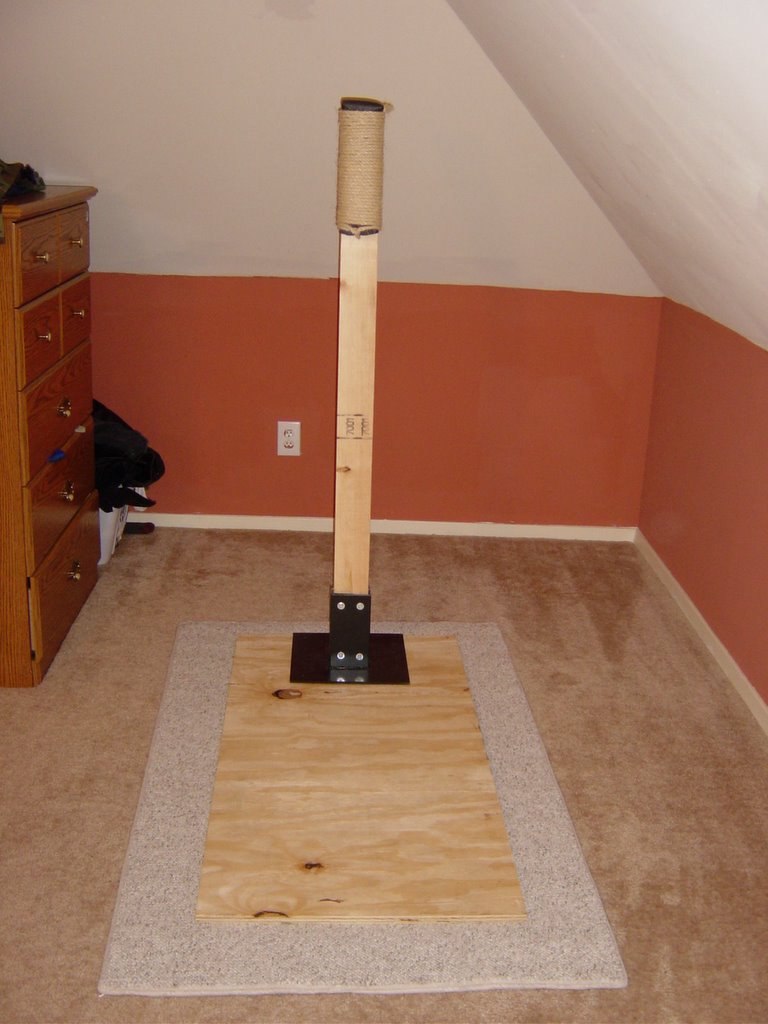
One of these ways was by striking the makiwara. Rather than being simply a method of toughening up your knuckles by striking a post covered in straw, it is actually meant to teach proper technique. The board should be flexible to have some "give". Otherwise, you are just harming your joints. Even still, a makiwara tends to tell you rather quickly if you are doing something wrong. A common critique of karate is that it involves people simply waving their hands in the air and punching the space in front of them. They fail to realize we the whole range that karate training encompasses. And before I sound like a cheesy advertisement, on to the next piece of equipment...
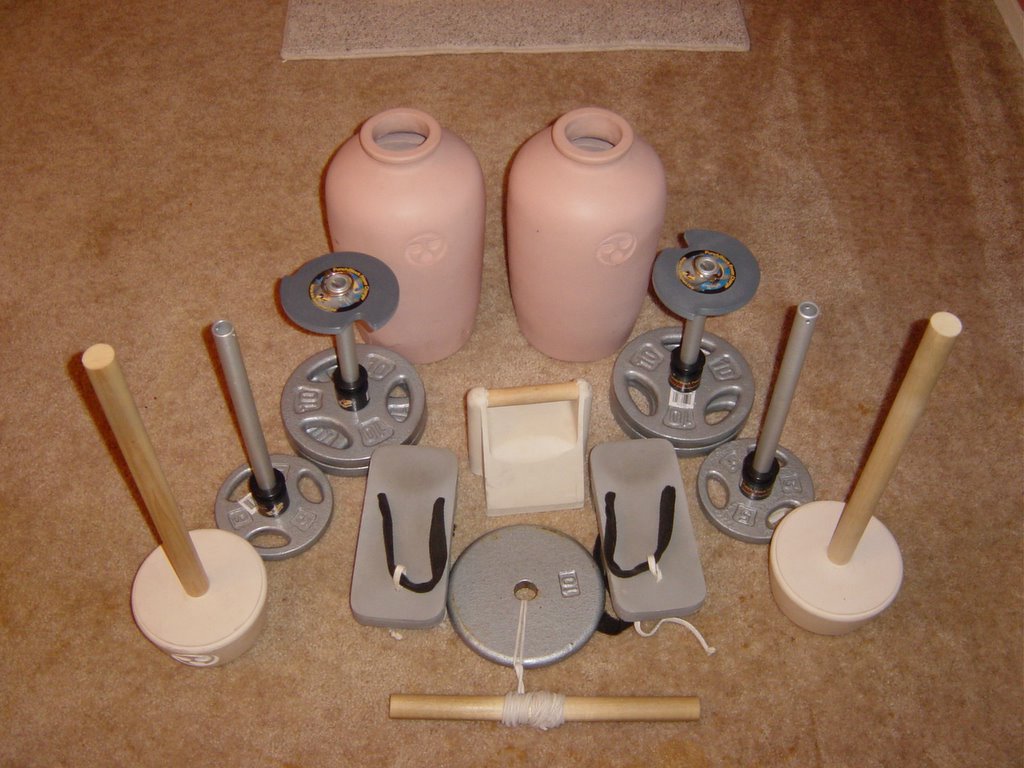
Another type of training was the use of various weights that specifically emphasized gripping strength. They are great for strengthening the fingers, the hand, the wrists, the forearms, the shoulders, trapezius muscles (and others...I'm not that great with anatomy). Great for striking or grappling and do a better job at targeting martial arts-specific muscles.
These are my set of traditional (or traditional-type) weight training devices. The jars, weight hammers, weighted sandals, and stone lock are from the store of Kyoshi Kevin Roberts. The two other sets are from BushiPower.com, which I enjoy using because it is easier to customize the weight-load by being able to use different plates. I've noticed significant increases in grip strength, including whenever I have to carry in a load of groceries...
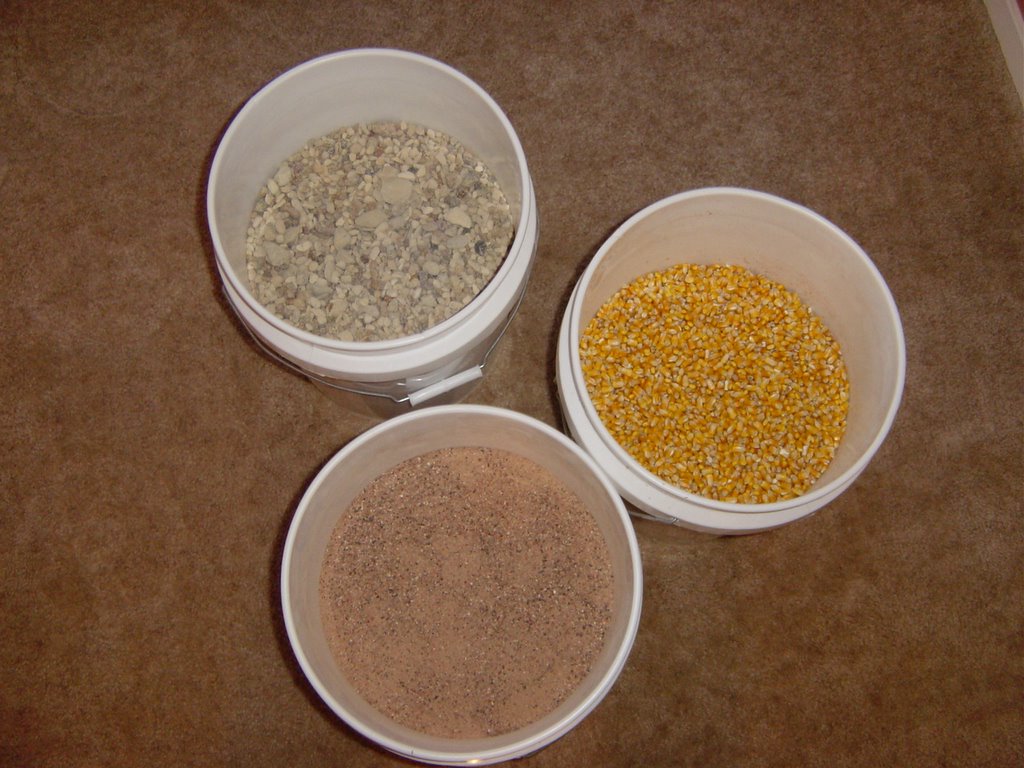
These are three large paint buckets, one with corn, one with pea gravel, and one with sand. I ended up getting these after taking the advice of Hanshi Ron Lindsey, an old school Shorin Ryu teacher. I had the opportunity to attend one of his seminars here in Texas and wanted his input on the type of training devices he used. He used much of the above (and some more), but he also recommended the buckets. Striking the corn and pea gravel with various types of finger strikes strengthens the surface of the fingers while striking the sand strengthens the joints as it only gives to a certain point. Also, digging deep into the corn and opening and closing your hand strengthens the muscles and connective tissue used in opening the hand, which is something most people do not work on. This aids especially in finger strikes as well as finger strength in general.

I recently starting to play piano again after a long leave of absence. A large part of my motivation was simply wanting to play the piano again. Another part was ensuring coordination in both hands and to keep working the fingers...don't laugh, it's true.
And of course, the benefits of all this is not limited to martial arts. I was playing basketball with a group of friends the other day when a rebound bounced hard off the rim and right into my fingers with a loud "thwack". People beside me winced in sympathy pain and one of them said I probably sprained a finger. I'm convinced I probably would have, but my fingers were absolutely fine...a cheesy example, but one that is true...
Technorati: karate Martial Arts martial-arts Self Defense fighting
Monday, December 19, 2005
Hanging Out With Onimitsu2004 Again
I spent last Saturday at Onimitsu2004's house when he was home from Hawaii visiting his folks in Texas for the holidays. It really was great seeing him again, as it's been roughly a year-and-a-half since I last saw him in person. And just like old times, we spent hours doing our karate together.
Unlike old times, he is now studying Pat Nakata's method of Shorin Ryu, thus being a Chibana Chosin method of Shorin Ryu (Kobayashi), as Nakata-Sensei was a direct student of legendary karate master Chibana. Nakata is also well-known among the Okinawans for being able to knock people out. Consequently, he would always use these terms like osae and backpull in ways I didn't understand. Or, he would come up with all these stories about Chibana which were pretty sweet. As time passed, he began to develop a physical understanding of these terms and gradually became able to do them with regularity. Whenever I saw the videos of the way he and Nakata performed the kata in their particular manner (which just looks kind of weird), I wasn't exactly skeptical, but I was very curious what it was all about. Last Saturday, I was able to feel the results. And as we say in karate, "feeling is believing".
I asked him to punch me (as I do many people) just to see how hard it is. Normally, most people (myself included) tend to punch in a manner that has a lot of surface impact but not a lot of penetration. Granted, I didn't block or even tense up to receive the blow (I normally don't), but he hit me far harder than all but a handful of people I've ever had hit me. I was doubled over for about ten seconds or so. I probably could've straightened up, but I was still in surprise at how hard it was. I was able to be just fine after that, but I felt him hit me in the chest and it felt like a mallet slammed me in the gut. He says I was supposed to feel it go straight in rather than drop, but since I kind of dropped too, I guess it was okay.
The rest of the time was spent comparing kata, explanations for various moves, and me trying to understand as much about all those terms Onimitsu2004 tosses around like leaves on a windy day. He would humorously sound like a someone from Hawaii whenever he tried to explain something in depth. He admitted that he couldn't help but adopt some mannerisms of his teacher when doing so. You could tell that not only is Nakata really good, but he is a good teacher as well, since Onimitsu2004 was able to explain things pretty well in person.
It really was like old times, although I found myself learning much more from him. All the same, I was able to hear many things that I have been told in my style (and Onimitsu2004's former style) of Shorinkan Shorin Ryu but didn't quite have it stick with me (stop looking down, "royal" posture, slow down more, etc.). All in all, it was a heck of a lot of fun. I look forward to the day that Onimitsu2004 comes out here to Goodfellow for Intel training next summer as there will be some overlap between my time here and his.
At the same time, it was almost kind of sad. There is a definite divergence between my karate and his. For now, I can see myself staying in the Shorin Ryu Shorinkan, but Onimitsu2004 will now most definitely remain a student of Nakata (and for good reason, too). His karate has become much more powerful like Nakata's while mine wants to become softer. I know I won't see him at a lot of the Shorinkan camps I go to. I seem to have chosen my way and he has chosen his. But you know, that's why I said "almost kind of sad", and not "kind of sad". In some ways, this represents the manner in which karate is supposed to evolve: along individual lines. If our karate remained identical, then it truly would be sad. I can see us decades down the road, sending students to each other just to see what "the other side" is about. And that is kind of cool.
After we did all our karate stuff, we went to a dessert party at someone else's house (which for a non-junk food eater like me simply involved a lot of talking and some fruit). After that, we went back to the house and sat around talking with his family, which was enjoyable as well. I'm sure Onimitsu2004 just loved all the stories that all parents love to tell about their kid when guests are over. I spent the night there and headed out the next morning. All told, well-worth the 8-9 hours of driving roundtrip.
Technorati: martial arts Karate personal combat self defense chibana chosin warrior kata bunkai shorin ryu shorinkan
Unlike old times, he is now studying Pat Nakata's method of Shorin Ryu, thus being a Chibana Chosin method of Shorin Ryu (Kobayashi), as Nakata-Sensei was a direct student of legendary karate master Chibana. Nakata is also well-known among the Okinawans for being able to knock people out. Consequently, he would always use these terms like osae and backpull in ways I didn't understand. Or, he would come up with all these stories about Chibana which were pretty sweet. As time passed, he began to develop a physical understanding of these terms and gradually became able to do them with regularity. Whenever I saw the videos of the way he and Nakata performed the kata in their particular manner (which just looks kind of weird), I wasn't exactly skeptical, but I was very curious what it was all about. Last Saturday, I was able to feel the results. And as we say in karate, "feeling is believing".
I asked him to punch me (as I do many people) just to see how hard it is. Normally, most people (myself included) tend to punch in a manner that has a lot of surface impact but not a lot of penetration. Granted, I didn't block or even tense up to receive the blow (I normally don't), but he hit me far harder than all but a handful of people I've ever had hit me. I was doubled over for about ten seconds or so. I probably could've straightened up, but I was still in surprise at how hard it was. I was able to be just fine after that, but I felt him hit me in the chest and it felt like a mallet slammed me in the gut. He says I was supposed to feel it go straight in rather than drop, but since I kind of dropped too, I guess it was okay.
The rest of the time was spent comparing kata, explanations for various moves, and me trying to understand as much about all those terms Onimitsu2004 tosses around like leaves on a windy day. He would humorously sound like a someone from Hawaii whenever he tried to explain something in depth. He admitted that he couldn't help but adopt some mannerisms of his teacher when doing so. You could tell that not only is Nakata really good, but he is a good teacher as well, since Onimitsu2004 was able to explain things pretty well in person.
It really was like old times, although I found myself learning much more from him. All the same, I was able to hear many things that I have been told in my style (and Onimitsu2004's former style) of Shorinkan Shorin Ryu but didn't quite have it stick with me (stop looking down, "royal" posture, slow down more, etc.). All in all, it was a heck of a lot of fun. I look forward to the day that Onimitsu2004 comes out here to Goodfellow for Intel training next summer as there will be some overlap between my time here and his.
At the same time, it was almost kind of sad. There is a definite divergence between my karate and his. For now, I can see myself staying in the Shorin Ryu Shorinkan, but Onimitsu2004 will now most definitely remain a student of Nakata (and for good reason, too). His karate has become much more powerful like Nakata's while mine wants to become softer. I know I won't see him at a lot of the Shorinkan camps I go to. I seem to have chosen my way and he has chosen his. But you know, that's why I said "almost kind of sad", and not "kind of sad". In some ways, this represents the manner in which karate is supposed to evolve: along individual lines. If our karate remained identical, then it truly would be sad. I can see us decades down the road, sending students to each other just to see what "the other side" is about. And that is kind of cool.
After we did all our karate stuff, we went to a dessert party at someone else's house (which for a non-junk food eater like me simply involved a lot of talking and some fruit). After that, we went back to the house and sat around talking with his family, which was enjoyable as well. I'm sure Onimitsu2004 just loved all the stories that all parents love to tell about their kid when guests are over. I spent the night there and headed out the next morning. All told, well-worth the 8-9 hours of driving roundtrip.
Technorati: martial arts Karate personal combat self defense chibana chosin warrior kata bunkai shorin ryu shorinkan
Subscribe to:
Posts (Atom)
